
| Battle | |

THE BATTLE OF NANTWICH & THE
WICKSTED FAMILY 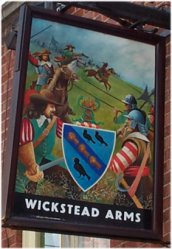
In Mill Street is the Wicksted Arms public house. Recently it has acquired a new inn sign, The scene on it is an artist`s impression of what the Battle of Nantwich on January 25th 1644 may have looked like. There is much colourful costume and banners and prancing horses!
Like the Wilbrahams, the Wicksted family were also landowners
and interested in the activities in the town. Some of them lived at Townwell
House, Welsh Row. This is the three-storeyed house, next but one to the
timber-framed cottage which projects on to the pavement at the widest part of
Welsh Row. Townwell also reminds us that here was one of the town`s five public
wells.
Richard Wicksted(1543-1623)was a churchwarden and a member of the
leet or court. He was one of the salt Rulers who determined when the boilings of
brine should take place and who set the strict rules governing the salt-making
processes and the sale of salt. He helped to make or amend the `Town Rules`(like
bye-laws)John was a mercer(trader in silks and fabrics)and a constable(one of
the three main officials in the town at that time). Thus he was involved in the
notorious case of Roger Crockett of the Crown Hotel,who was murdered in
1572.
Richard the younger(?1613-52)was a Royalist and had some of his
property confiscated, only to be forgiven later.Thomas a freeholder in 1666 was
a treasurer for the town and a royalist.A later Thomas was a lawyer and,in 1732,
appointed as one of the trustees to manage the Wright almshouses, once in London
Road, but moved stone by stone to a position at the rear of the Crewe almshouses
in Beam Street.
John Wicksted gave some money for a south gallery in the
church in 1730. The principal families then sat in this gallery until the 1850s.
He helped to amend the Town Rules in 1834. He and a successor, Thomas, tried to
get an act passed in Parliament relating to the town but were
unsuccessful.
A Richard Wicksted(1750-1810) was a doctor and in 1779, a
shareholder in the new Workhouse off Barony Road.
A burial stone can be
seen in St George`s chapel in the North Transept of St Mary`s church. Going back
to the 1640s when England was up in arms regarding who should rule - king or
Parliament. The dispute led to skirmishes and battles in many parts of the
country. One small battle took place in fields between Nantwich and Acton,
approximately where the canal passes today.
Nantwich decided to support the Parliamentarian cause and set up local headquarters in The Lamb Hotel in Hospital Street For three weeks the town was under siege but in January 1644 a movement towards oncoming Royalists near Dorfold Hall resulted in the Battle of Nantwich. It started in the afternoon of January 25th, a cold wintry day and early dark. The Royalists.sought to capture Nantwich by a pincer movement and met much frustration in crossing the river Weaver at a point near today`s Beam Bridge.
The Parliamentarians advanced towards Acton, defeated the Royalists and set them to flight. The leader General Thomas Fairfax is now recalled in the name of the new bridge over the river near to the swimming baths. And again in the re-enactment of the battle which takes place on the last Saturday in January each year. This is presented by 300 or 400 Sealed Knot actors, dressed in the costumes of the time together with their very long pikes, muskets and canon, but no horses.
The event is a great attraction. Many people watch the men and women march from the Square, down Mill Street to the Mill Island where there will be seen much preparation, advances, great pushing at close quarters, several `dead` , and earth-shaking sounds from canon fire! The Museum has a detailed account with maps, diagrams, and a copy of the Fairfax letter.
Upstairs is a woven tapestry of a scene from the battle - snow on the ground and a church in the background. Although the battle is often omitted in full written accounts of the Civil Wars, a long account is reprinted in James Hall`s History of Nantwich,1883, and the full story in R.N.Dore and John Lowe`s Battle of Nantwich 25th January 1644 in Nantwich Library